
Master Sampling in Jewelry OEM Work: 25–30 Days
Master sampling is the longest stage most buyers ever see, and it is quoted as 25–30 days because five operations run in sequence inside it. Wax printing, mould casting, stone setting, polishing and custom electroplating each finish before the next begins, and the output is one physical piece for approval. Set against a 48-hour CAD stage, the sample is roughly half of the whole development cycle.

Key takeaways
- The published sample window is 25–30 days, or 3.6–4.3 weeks.
- CAD is under 48 hours, which is 6.7–8% of the sample window.
- A second sample round adds another 25–30 days to the schedule.
- Bulk production follows at 21–28 days with 100% inspection.
The five operations inside the window
Sampling starts with a 3D wax print of the approved file. The print is invested, burned out and cast in the chosen metal, which is why the material decision has to be fixed before this point rather than after.
Casting is followed by sprue cutting and cleanup. The raw piece then goes to stone setting if the design carries stones or pearls, and to polishing if it does not. Setting is labour-heavy, because each seat is cut and each stone is seated and checked by eye.
Polishing brings the surface to its final gloss before plating. Plating is the last operation: multi-layer gold or rhodium on silver and brass, PVD vacuum coating on stainless steel. Silver and brass also take an anti-tarnish e-coating after plating.
Only then does the piece go to review. A brand comparing timelines from any OEM ODM jewelry manufacturer should ask which of these five steps the quoted days include, because a window that stops at casting is not the same promise. In the full OEM/ODM sequence, sampling is the fourth of six steps, and it is the only one where a single piece is handled five times.
Why the answer is a range, not a date
The 25–30 day band absorbs three variables. The first is design complexity: a plain band and a multi-stone pendant do not consume the same setting time. The second is finish: a two-tone piece with masked plating needs more handling than a single colour.
The third is queue position. A sample is a single piece moving through a line built for batches, so it waits for each station. That waiting is normal and is part of what the range covers.
ISO 9001:2015 matters here in a quiet way. The standard asks for control across production stages, which in practice means the sample route is documented and the same steps are followed for a repeat order. A sample that cannot be reproduced in bulk is a demonstration, not a master.
This is also why the same factory can quote 25 days for one design and 30 for another without either number being an excuse. The range is the honest shape of a hand-finished process.
CAD takes two days; approval takes the rest
3D CAD is published at under 48 hours, with realistic renderings for dimension sign-off. Two days is fast enough that buyers sometimes treat the file stage as trivial and spend their attention on the sample instead.
The arithmetic argues the other way. Two days against a 25-day sample is 48/600 = 8%. Against 30 days it is 48/720 = 6.7%. The file stage is a small slice of the calendar, but it decides everything downstream, because the sample is cut from it.
Approval is the part with no published duration, because it belongs to the buyer. A comment round that takes a week is a week added to a 25–30 day window, and a second physical round adds the full window again.
The practical discipline is to collect every comment into one response: dimensions, stone placement, finish, hallmark and packaging. Split feedback across three emails over ten days and the sample restarts three times.
What a buyer can compress, and what they cannot
A buyer cannot shorten casting, setting or plating by asking. Those are physical operations with fixed handling. A buyer can shorten the queue by supplying a complete brief, and can shorten the loop by approving in one round.
The lowest-cost compression is upstream. Deciding the base material, the plating colour and the stone list before CAD removes the rework that usually appears at sample review, when a change costs a new print and a new cast.
The other lever is batching. Two designs submitted together share one review cycle, so the calendar cost is 25–30 days for both rather than 50–60 days in sequence.
| Stage | Published figure | Buyer input needed |
|---|---|---|
| Inquiry and response | 24 hours | Brief, references, target material |
| CAD and prototype | Under 48 hours | Dimension sign-off |
| Master sampling | 25–30 days | One consolidated comment round |
| Bulk production | 21–28 days | Approved sample and order |
| Final QC and delivery | 100% inspected | Packing and shipping details |
Read the table as a chain rather than a menu. Every row waits for the one above it, and the buyer controls two of the five inputs.
Worked example
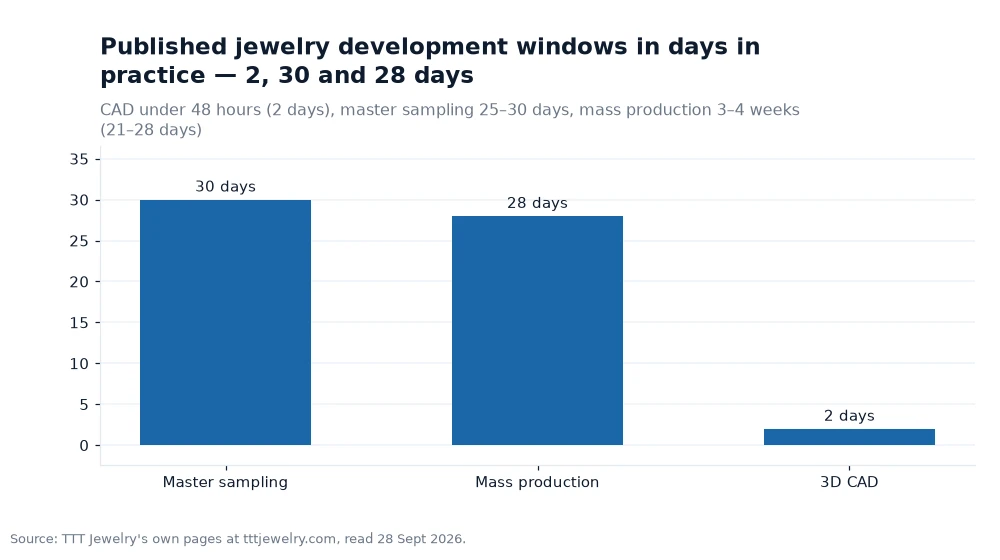
A brand submits one design and approves it after a single comment round. The calendar is 2 days of CAD, 30 days of sampling and 28 days of production, which is 2 + 30 + 28 = 60 days, or 8.6 weeks. At the fast end it is 2 + 25 + 21 = 48 days, or 6.9 weeks.
Now suppose the first sample comes back with a stone seat that sits too high. A corrected sample adds another 25–30 days, so the same order lands at 73–90 days, or 10.4–12.9 weeks. The delay is larger than the entire CAD stage by a factor of 12 or more.
Sampling is also the biggest single block in the cycle. At 25 days it is 25/48 = 52% of the fast schedule; at 30 days it is 30/60 = 50% of the slow one. Roughly half of the time from brief to delivery is spent making one piece right.
That share explains why buyers who compress the sample usually do it by preparing better input, not by negotiating the number down. The published window already assumes a clean file.
Frequently asked questions
Does 25–30 days cover every material?
The published window is the same for a master sample in silver, brass or stainless steel, but the finishing step differs: silver and brass take electroplating with an anti-tarnish e-coating, while stainless takes PVD vacuum plating.
Can sampling begin before the CAD file is signed off?
No. The CAD stage is published at under 48 hours and the sample is built from the approved file, so releasing tooling early only moves a dimension error into metal.
Is shipping included in the sampling window?
It is not. The window ends at an approved physical sample, and bulk production then runs 21–28 days before final QC and delivery.
Reading a sampling quote correctly
Ask three questions of any quote: when the clock starts, what the sample includes, and what happens if a comment arrives after casting. The answers separate a 25-day window from a 25-day wish.
Most of the risk sits in the handover between file and metal. A sterling silver jewelry manufacturer that casts, sets and plates in one line keeps that handover inside a single schedule, which is why the sample date is easier to hold.
For designs headed to brass, the custom brass jewelry route follows the same five operations, with a 100-piece minimum once the sample is approved. The timeline does not change; only the metal and the floor do.
Treat 25–30 days as the length of the sample itself, then add the buyer's own review time. That total, not the quoted band, is what the launch date should be built on.
Source note: figures come from the manufacturer's own website (tttjewelry.com), read 28 Sept 2026.[1]